
The Complete Soft Autumn Color Palette Guide
Muted. Warm. Quietly radiant.
The soft autumn color palette is one of the most nuanced of the 12 color seasons — rich enough to feel autumnal, yet gentle enough to carry the whisper of summer. If your coloring blends rather than contrasts, and warm tones feel more natural on you than cool ones, you may have found your season.
This guide covers everything: characteristics, hex codes, what to wear, what to avoid, and how to finally confirm whether you are a soft autumn.
What Is the Soft Autumn Color Season?
The soft autumn is one of three autumn seasons in the 12-season color analysis system, sitting between soft summer and true autumn on the seasonal flow chart. It draws on the earthy depth of autumn while being softened by a strong summer influence — the result is a color season that is both warm and muted, never harsh, never stark.
To understand soft autumn, it helps to understand its two defining color aspects:
Primary aspect: Muted (low chroma) The most important quality of soft autumn is that its colors are desaturated and toned down. Nothing in this palette is vivid or bright. The colors carry a natural softness, as though a thin veil of grey has been laid over them to quiet their intensity.
Secondary aspect: Warm Soft autumn’s colors lean toward the warm end of the spectrum — they carry more yellow undertones than blue. This warmth distinguishes soft autumn from its sister season, soft summer, which shares the same muted quality but runs cool instead.
Think of the landscape in early autumn — hazy afternoon light over fields ready for harvest, the soft gold of dried grasses, the muted green of sage, the dusty pink of rosehip. These are soft autumn colors. Gentle, rich, and deeply earthy.
The three color dimensions of soft autumn
Every color season can be mapped across three dimensions of color. Here is where soft autumn sits:
Hue (warm to cool): Soft autumn sits on the warm side of neutral. Its colors contain more yellow undertones than blue, which is why you will find very few pure blues on the palette, and those that do appear skew toward warm turquoise rather than cool cobalt.
Value (light to dark): Soft autumn is medium in value. There are no stark whites or deep blacks. Colors cluster in the middle range — neither overly light nor deeply dark. This medium value is what gives soft autumn its blending, harmonious quality.
Chroma (muted to bright): This is where soft autumn is most distinctive. It has the lowest tolerance for brightness of all the autumn seasons. Its colors are low in chroma — muted, dusty, and never saturated. This is the primary color aspect and the one that defines the season above all else.
Am I a Soft Autumn? Characteristics & Self-Test
Soft autumn is defined by an overall appearance that blends rather than contrasts. When you look in the mirror, your skin, eyes, and hair seem to melt into one another. There are no dramatically light or dark areas. Instead, your coloring reads as harmonious, medium-toned, and quietly warm.
You are a soft autumn if:
- Your overall appearance is muted — features appear slightly “greyed out” or toned down rather than vivid
- The contrast between your skin, hair, and eyes is low to medium
- Warm tones (gold jewelry, camel, olive) feel more natural on you than cool tones (silver jewelry, cool grey, navy)
- True black near your face makes you look drained or harsh
True white near your face looks stark and unflattering
Soft Autumn eyes
Soft autumn eyes tend to be green, light hazel, or light brown. They often carry a hint of grey that gives them a muted, softened appearance. You may notice freckle-like specks on the iris, and the borders of the iris often appear slightly blurred or irregular — a characteristic of the autumn eye family. Blue eyes in soft autumn are warm and greyed, not bright or icy. In deeper skin tones, the eyes may be a medium warm brown that reads soft rather than vivid.
Soft Autumn skin
Soft autumn skin is neutral to neutral-warm. Both gold and silver jewelry can look acceptable, but gold is always the more flattering choice. Skin tone ranges from fair to tan, often with a hint of sand, peach, or yellow. When placed against vibrant colors, soft autumn skin may appear dull. Against true black, it can look yellowish or sallow. The skin does not have olive undertones as strong as true autumn, nor the pinkish cast of soft summer.
Soft Autumn hair
Soft autumn hair ranges from strawberry blonde to golden blonde to medium golden brown. It is rarely very light or very dark. The hair may appear slightly ashy in indoor light — a reflection of the season’s muted quality — but in sunlight, golden and honey highlights emerge. Hair that is too dark (black, very deep brown) or too ashy without warmth is unlikely to be soft autumn.
Soft Autumn contrast
The contrast level between soft autumn features is low to medium. The hair is somewhat darker than the skin, but the difference is never dramatic. There are no truly light or truly dark areas pulling the eye. Everything reads at a similar medium value, which is why the overall impression is one of blending harmony rather than striking contrast.
Self-test: how to tell if you are a soft autumn
The soft autumn color palette takes its inspiration from the earth in early harvest season — hazy, warm, and full of quiet nuance. These are the colors of dried grasses, walnut shells, aged leather, sage, and dusty rose. Every color on the palette shares the same two qualities: low chroma (muted, not vivid) and a neutral-warm hue (more yellow than blue).
Here is the complete soft autumn color palette, organized by color family with hex codes.
Soft Autumn Neutrals
Neutrals are the foundation of any wardrobe, and soft autumn’s neutrals are the key to a cohesive, flattering closet. Note that true black and true white are not soft autumn colors — they belong to winter. Replace them with the following.
Dark neutrals (replace black with these):
Warm Dark Brown
The closest replacement for black — deep and grounding but warm
Dark Walnut
A rich brown-black with red undertones
Dusty Warm Grey
The nearest soft autumn has to a true grey-black
Dark Olive
A dark, muted green-brown — excellent for bottoms and outerwear
Deep Moss
Dark green with earthy warmth
Light neutrals (replace white with these):
Warm Ivory
Yellowish off-white — the closest to white for soft autumn
Parchment
A warm, papery neutral , flattering near the face
Sand
A deeper warm beige, excellent as a base neutral
Camel
Medium warm tan — one of the most versatile soft autumn neutrals
Warm Taupe
Pinkish-grey with warm undertones
Soft Autumn Greens
Greens are one of the strongest color families on the soft autumn palette, thanks to their naturally yellow-based undertones.
Sage
The signature soft autumn green — muted, herbal, and flattering
Warm Olive
A deeper, more yellow-green
Fern
A medium dusty green
Moss Green
Darker and earthier — excellent for outerwear
Muted Khaki
A warm yellow-green that reads almost neutral
Dusty Jade
A cooler green but warm enough for soft autumn
Soft Autumn Reds, Pinks & Rusts
Unlike true autumn’s bold oranges, soft autumn’s reds and pinks are gentle and dusty — never vivid.
Dusty Rose
A muted, warm pink — one of the most beautiful soft autumn colors
Terracotta Pink
A warm, earthy pink with orange undertones
Muted Coral
Gentle coral — more dusty than bright
Warm Mauve
A pinkish-grey with warmth
Oxblood Red
A deep, muted red — for those who lean toward soft summer
Dusty Brick
A muted, earthy red
Cinnamon
Warm spice tone — one of soft autumn’s most wearable accents
Soft Autumn Blues & Teals
Blue is the coolest color, which is why it appears sparingly on soft autumn’s palette. Only the warmest, most muted blues make the cut.
Muted Teal
Warm teal — the most flattering blue-family color for soft autumn
Dusty Turquoise
A warm, softened turquoise
Steel Blue-Grey
A cooler grey-blue — use sparingly
Warm Denim
A muted, warm blue — better than cool navy
Soft Autumn Browns & Golds
Browns and golds are where soft autumn truly shines — these colors mirror the natural warmth in soft autumn coloring directly.
Warm Caramel
A medium golden brown — endlessly wearable
Honey
A warm, muted gold
Golden Apricot
Soft warm peach-gold — for those leaning true autumn
Muskmelon
A warm peachy tone on the palette’s warmer edge
Hazelnut
A medium warm brown
Antique Gold
A deep, muted gold — excellent for accessories
Warm Mushroom
A muted greige with warmth
Take your soft autumn palette everywhere.
Our printable Soft Autumn Colour Palette Chart includes every color with hex codes, organized by category — perfect for shopping, styling, and building your wardrobe. → Get the Palette Chart — $19.99
Soft Autumn vs Soft Summer: How to Tell the Difference
Soft autumn and soft summer are the two most frequently confused color seasons. Both share the same primary color aspect — muted, low chroma, desaturated — which makes them visually very similar. The distinction lies in undertone.
| Feature | Soft Autumn | Soft Summer |
|---|---|---|
| Primary aspect | Muted | Muted |
| Secondary aspect | Warm | Cool |
| Undertone | Neutral-warm (gold > silver) | Neutral-cool (silver > gold) |
| Eye quality | Green, hazel, warm brown — retain color in grey test | Eyes appear greyed in grey test |
| Skin quality | Sand, peach, or yellow hint | Pinkish, rose, or ash hint |
| Hair quality | Golden blonde to golden brown | Ash blonde to ash brown |
| Best neutrals | Warm ivory, camel, warm taupe | Cool ivory, rose beige, warm grey |
| Best metals | Brushed gold, rose gold, bronze | Silver, pewter, white gold |
| Worst color | True black, electric orange, cobalt | True black, orange, warm yellow |
| Worst metal | Bright shiny silver | Bright shiny yellow gold |
The key insight: both seasons are muted, but soft autumn is muted-warm and soft summer is muted-cool. If you are genuinely on the border, do the grey-cloth test described in Section 2. Your eyes will tell you which direction your pigmentation leans.
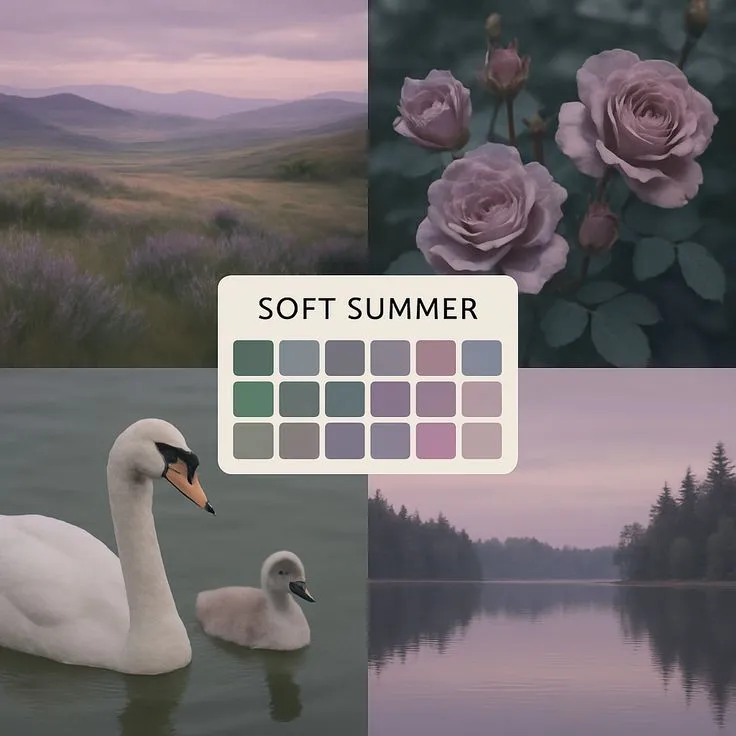
How Does Soft Summer Compare to Other Seasons?
Soft Summer is cool, muted, and balanced — but how does it differ from Soft Autumn or Cool Winter?
Explore our color season comparison charts to see where Soft Summer fits in the 12-season system.
Soft Summer vs Soft Autumn: Find Your True Season
It’s easy to confuse Soft Summer with Soft Autumn — both belong to the soft family, meaning their colors are gentle, blended, and never harsh.
But while they share that muted quality, the difference lies in temperature:
Soft Summer is cool and delicate, built around blue undertones, rose-tinted neutrals, and misty gray hues.
Soft Autumn, on the other hand, is warm and earthy, glowing with taupe, olive, and soft golden undertones.
If silver jewelry flatters you more than gold and cool pastels feel natural on your skin, you likely belong to the Soft Summer palette.
If warm browns, mossy greens, and peachy tones bring out your glow, you might lean toward Soft Autumn instead.
Understanding the difference helps you choose the right colors for your wardrobe, hair, and makeup, and ensures every shade enhances your natural beauty.
See the Soft Summer Palette in Action
Muted mauves, smoky blues, and silver-gray neutrals — every Soft Summer outfit creates quiet elegance.
Our outfit ideas show how simple color harmony transforms your wardrobe.
FAQ'S
What defines a Soft Summer color palette?
Cool, muted, and pastel tones that create a soft and natural look.
What are the best colors for Soft Summer individuals?
Icy pink, rose beige, soft blue, misty gray, lavender, and silver work best.
Why should Soft Summers avoid warm tones?
Warm, saturated colors like bright oranges and earthy browns create too much contrast and overpower their delicate undertones.
What accessories suit Soft Summers best?
- Silver jewelry, soft-textured fabrics, and pastel layering help maintain a harmonious, elegant appearance.
How can Soft Summers style their wardrobe effectively?
By choosing muted tones, gentle layering, and cool-toned pastels, they can achieve a balanced and sophisticated look.
What makes Soft Summer unique?
- Soft Summer is defined by muted, cool, and desaturated tones that bring understated elegance rather than high contrast.
Where does Soft Summer fit in the seasonal flow chart?
Soft Summer sits between True Summer and Soft Autumn, leaning more towards Summer’s coolness.
How does Soft Summer differ from Soft Autumn?
- Soft Summer is cool, while Soft Autumn carries warmer undertones influenced by Autumn.
Why do desaturated colors suit Soft Summer individuals?
Unlike other seasons, Soft Summers look balanced and elegant in greyed-out shades, which prevent overpowering contrast.
What is the main styling approach for Soft Summer?
Choosing subtle, soft-toned colors and avoiding bold or overly warm shades ensures a naturally balanced, elegant look.
What defines the Soft Summer color season?
- Soft Summer is a cool, muted season with low contrast, featuring soft, grey, and desaturated tones.
What are the common eye colors for Soft Summers?
Grayish blue, green, or brown are typical Soft Summer eye colors.
How can you identify Soft Summer skin tones?
- Neutral to neutral-cool skin tones with ashy or pink undertones are common.
What hair colors suit Soft Summer individuals?
Ash-toned shades from ash blonde to dark ash brown, often darker than other Summer seasons.
Can people of color be Soft Summers?
- Yes! Soft Summer characteristics can appear in diverse backgrounds, and color analysis should be inclusive rather than strictly based on lighter skin tones.
What skin undertones are common in Soft Summers?
Soft Summers have slightly cool skin with ashy and pink undertones, sometimes appearing neutral-cool or lightly tanned.
What do Soft Summer eyes look like?
They have a greyish tint, whether blue, green, brown, or grey hazel, giving them a soft, muted look.
How does contrast appear in Soft Summers?
Soft Summer features blend together, with low contrast between hair, skin, and eyes, creating a subtle, ashy look.
What are common lip colors for Soft Summers?
- Soft Summer lips have natural pink undertones, making them appear soft pink even without lipstick.
What hair colors suit Soft Summers?
Cool, ashy tones from ash blonde to dark ash brown, avoiding warm or red undertones.
Is vein analysis an accurate way to determine Soft Summer?
No, vein analysis alone isn’t reliable. Instead, assessing contrast levels, undertones, and overall blending gives a more accurate result.
How do I know if I am a Soft Summer?
Your overall appearance is muted, and cool tones suit you better than warm ones.
What does Soft Summer coloring look like?
Skin, eyes, and hair blend together, creating a soft, toned-down appearance rather than a bright or vibrant one.
What is the contrast level of a Soft Summer?
Low to medium contrast, meaning your features blend instead of standing out sharply.
What undertones does a Soft Summer have?
Cool undertones, making silver jewelry more flattering than gold.
Which colors suit Soft Summers best?
Cool, muted shades rather than warm or overly bright tones.

Upcoming Events

Everest Camp Trek

Walking Holidays
Explore The World
Upcoming Tours & Destination
Fuerat aestu carentem habentia spectent tonitrua mutastis locavit liberioris. Sinistra possedit litora ut nabataeaque. Setucant coepyterunt perveniunt animal! Concordi aurea nabataeaque seductaque constaque cepit sublime flexi nullus.